Bioplastics Lab
Wheat Straw in Bioplastics: This project engineers wheat-straw-filled polymer composites to reduce virgin plastic usage while preserving manufacturability and targeted performance. The work systematically studies how straw morphology and formulation choices influence melt processing behavior, interfacial bonding, and resulting mechanical response. Outcomes include design guidance for scalable composite production, improved utilization of an underused agricultural residue, and pathways that can reduce cost and environmental footprint while creating additional value for regional farming communities.
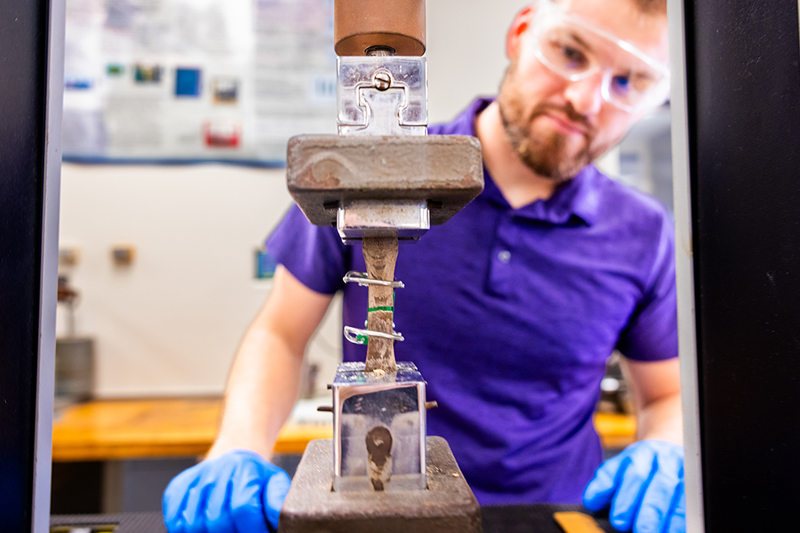
Soy-based Utensils: This project develops soy-protein-derived bioplastic formulations designed for conventional forming routes used in high-throughput manufacturing of food-service items and packaging. Research focuses on achieving stable processing, adequate toughness and stiffness balance, and moisture/thermal robustness using fully food-appropriate, bio-based formulation strategies. Candidate materials are evaluated using standardized mechanical and processing characterization along with end-of-life and food-contact considerations, enabling practical translation from lab-scale compounding to pilot-scale production.
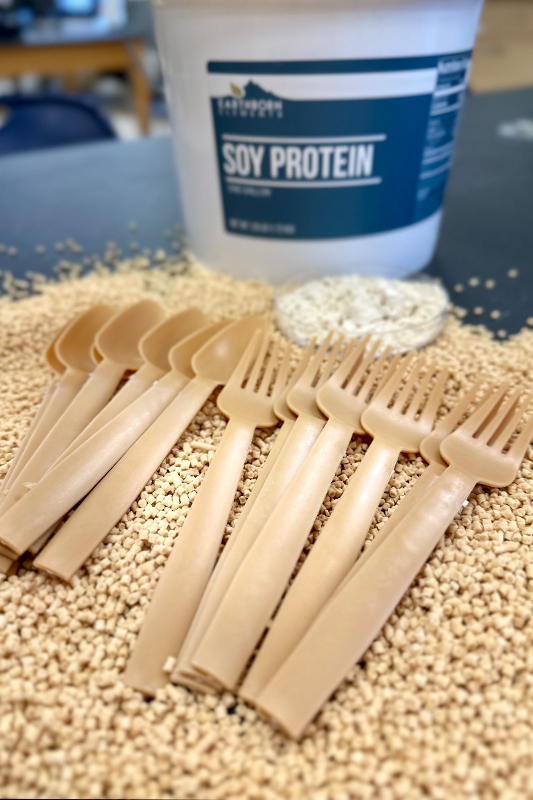
Edible Clear Plastic Films: This project creates edible, optically clear films and coatings derived from soy-protein-based systems to replace short-lived plastics and improve food preservation. The approach integrates food-safe structuring and crosslinking strategies to enhance strength, flexibility, and barrier functionality while maintaining transparency and palatability. Materials are produced via scalable casting or coating routes and assessed through standardized mechanical and barrier testing, followed by shelf-life validation on produce to quantify moisture retention, quality preservation, and reduced packaging demand.

SPI–CNF Edible Spray Coatings: This project formulates spray-applied edible coatings that form a thin, transparent, biodegradable barrier on fresh produce to reduce moisture loss and slow quality degradation. Research emphasizes droplet formation, wetting and adhesion on natural waxy surfaces, and rapid formation of a uniform continuous layer without sensory impact. Performance is quantified through controlled storage studies comparing coated versus uncoated produce, focusing on mass loss, appearance retention, and spoilage indicators, with the aim of replacing synthetic waxes and reducing reliance on plastic wraps.

Flexible Hemp Materials: This project designs flexible natural-fiber-reinforced composites that couple renewable content with tunable mechanical performance for flexible-product applications. The research explores how polymer-blend architecture, fiber dispersion, and interfacial engineering govern strength–elongation tradeoffs, tear resistance, and process stability. By adjusting formulation levers without compromising flexibility, the work targets materials that remain formable and durable while enabling cost reduction through increased bio-derived content and scalable compounding methods.
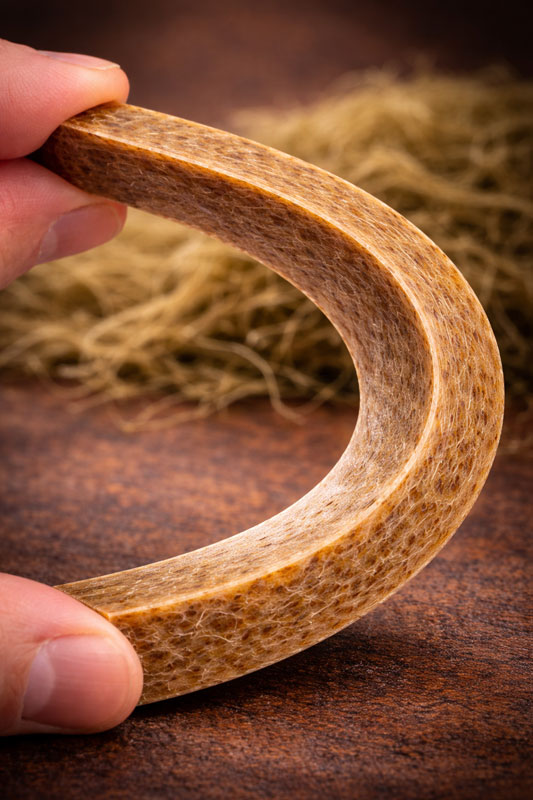
Structural Hemp Materials: This project develops high-performance hemp-based structural composites intended for building applications where stiffness, strength, dimensional stability, and surface quality are critical. The work leverages thermoset architectures and fiber-rich designs to achieve construction-relevant mechanical performance while prioritizing manufacturability and appearance. A distinctive thrust is improving fire performance and overall sustainability through bio-sourced chemistry pathways, aligning structural-grade functionality with renewable feedstocks and responsible end-of-life considerations.

Biodegradable Circuit Board: This project advances biodegradable printed circuit board laminates and prototype boards based on crop-derived resin systems reinforced with plant fibers. The workflow spans materials synthesis and formulation, laminate fabrication, and prototype PCB build-and-test, with emphasis on electrical reliability, mechanical integrity, and processing compatibility with standard electronics assembly concepts. The overarching objective is electronics hardware with lower toxicity, improved end-of-life options, and resilient domestic sourcing while maintaining performance expectations for functional prototypes.
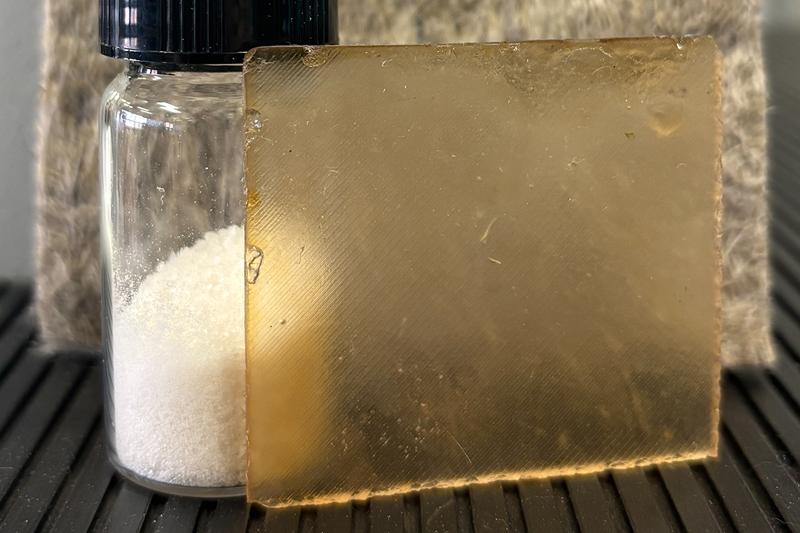
Soy Hulls to Lactic Acid: This project establishes a regional biorefinery pathway converting soy-processing residues into a key bio-based platform chemical and subsequently into widely used biopolymer materials. The research integrates pretreatment, biochemical conversion, purification, and polymerization logic into a coherent supply-chain concept that can support films, molded goods, and other commodity formats. Key value propositions include upgrading a low-value byproduct, reducing dependence on petrochemical routes, leveraging fermentation know-how, and enabling coproduct utilization to strengthen overall process sustainability.

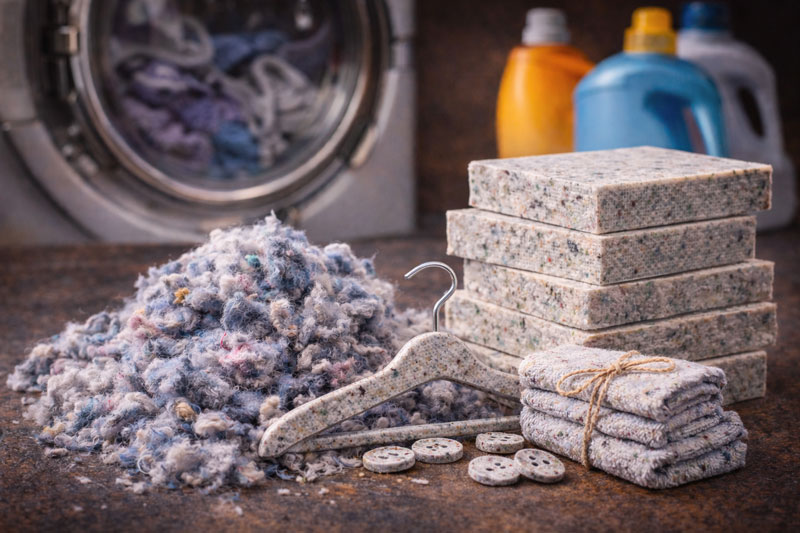
Lint-Based Biocomposites: This project addresses microplastics by upcycling laundry lint from synthetic textiles into functional filler for polymer composites, diverting a pervasive waste stream toward durable material uses. The approach emphasizes minimal preprocessing and scalable forming routes, then evaluates dispersion, interfacial behavior, and mechanical performance relative to conventional commodity plastics benchmarks. The outcome is a practical strategy to reduce virgin polymer demand, valorize household waste, and generate materials suitable for everyday applications while contributing to microplastics mitigation.
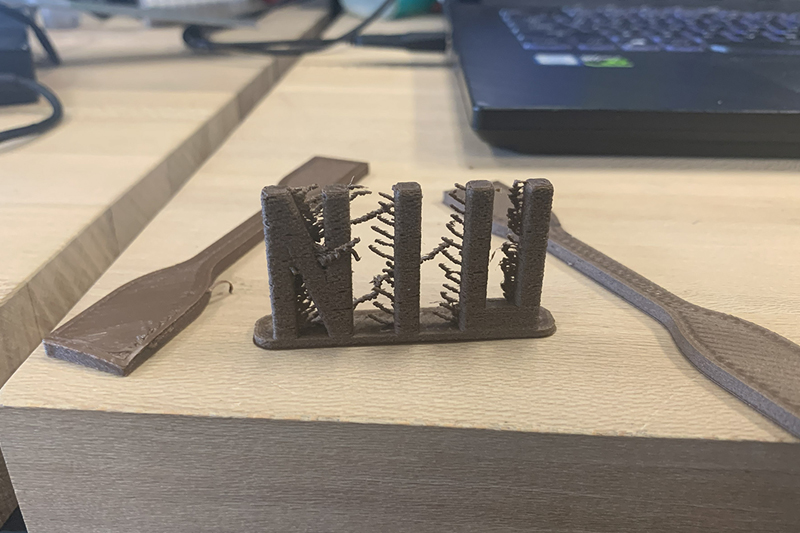
Bio-filaments for 3D Printing: This project develops composite filaments for additive manufacturing using bio-based and hybrid matrices reinforced with natural fibers, enabling demonstrably functional prints rather than purely aesthetic prototypes. Research targets filament consistency, extrusion stability, printability, and part performance, linking formulation choices to layer adhesion, surface finish, and mechanical response in printed geometries. The program supports rapid iteration from biomass-derived feedstocks to printed components, providing a scalable pathway for sustainable prototyping and small-batch manufacturing.
Note: unless otherwise labeled, the images on this page were AI-generated with ChatGPT by the faculty member for illustrative purposes related to these projects.
Manufacturing and Processing
- Injection molding
- Compression molding
- Extrusion
- Blow molding
- Thermoforming
- Rotational molding
- Composite hand-layup
- Pelletizing
- 3D-printing
- Post-processing
Mechanical Testing
ASTM/ISO-compliant equipment for:
- Tensile testing (ASTM D638)
- Impact resistance (ASTM D256)
- Puncture resistance (ASTM F1306)
- Tear resistance (ASTM D1004)
- Compression strength (ASTM D695)
- Compressive creep (ASTM D621)
- Wear and abrasion (ASTM D4060)
- Shore hardness (ASTM D2240)
- UV aging (ASTM G154)
- Accelerated degradation (ASTM D5338)
- Fractographic imaging (via SEM for crack/fiber analysis)
Barrier and Shelf-Life Testing
ASTM-based barrier testing:
- Water Vapor Transmission Rate (WVTR) – ASTM E96
- Oxygen Transmission Rate (OTR) – ASTM D3985
- Oil/grease resistance – ASTM D7227
Real-world simulation chambers:
- Cold storage (4°C) and ambient (23°C/50% RH) testing
- Shelf-life assessment via:
- Weight loss
- Moisture retention
- Firmness (ASABE S368.4)
- Color changes (CIELAB colorimetry)
- Microbial growth (ASTM E2149)
Environmental and Regulatory Compliance Testing
Compostability:
- ASTM D6400 and EN 13432 (≥90% degradation within 180 days)
- Soil toxicity (ISO 17556, OECD 208)
Food-contact safety:
- EU 10/2011, Japan’s Positive List System
- Simulant migration testing (e.g., olive oil, water, acetic acid)
Recyclability:
- Mechanical recyclability (re-extrusion, property retention)
- Chemical recyclability (solvent-based depolymerization)
Microbial safety testing:
- Intertek-supported microbial activity evaluation on degraded materials
Material Science and Characterization
Thermal and mechanical property optimization through:
- Fiber surface treatments (alkali, silane)
- Plasticizer-controlled processing
- Hybrid reinforcement (e.g., soy protein isolate)
- Compatibilizer use (e.g., MA-g-PLA)
Permeability and antimicrobial control through:
- Chitosan/essential oil coatings
- PLA/PHB-starch composites
- Waxes (soy, carnauba) for barrier improvement
Pilot Readiness and Scalability
- Facility supports real-time production and validation of bio-composites without third-party scale-up
- Thermoforming simulations at 140–180°C with vacuum pressure
- Thickness and mold fidelity assessments for packaging products
Biodegradable Bio-composites for Food, Packaging and Pharmaceutical Industries
- Food-safe packaging
- Complies with FDA 21 CFR and EU Regulation (EC) Nos. 1935/2004 & EU 10/2011
- Enhanced with plant-based coatings for antimicrobial and barrier performance
- Biodegradable utensils
- Meeting ASTM D6400 and EN 13432 compostability standards
- Approved for direct food contact under FDA and EU migration limits
- Clear wrappers and barrier films
- For nuts and snack foods with high oil and moisture resistance
- Tailored for shelf stability and cold-chain logistics
- Thermoformed trays and breathable films
- For fruits, vegetables, and herbs
- Pharmaceutical and cosmetic packaging
- Compliant with USP <661.1> and <87>/<88> for biocompatibility and extractables/leachables
- Suitable for primary packaging of solid dosage form, also for creams, gels, and ointments with non-reactive, plant-based liners
Bio-composites for General Industrial Applications
Pellets, machinable blanks and 3D printing filaments
- Developed using agricultural residues as fillers or reinforcement for durable, high-performance materials
- Optimized for dimensional stability, heat resistance, and surface finish quality
- Customizable for automotive, consumer goods, and electronic housings
- Available in biodegradable and partially bio-based resin systems
- Designed to reduce carbon footprint and offer end-of-life options (composting, recycling, or energy recovery)
Material Development and Manufacturing
- Injection molding, compression molding, extrusion, and blow molding (see Bioplastics Lab. Equipment)
- Composite hand-layup and 3D-printing capabilities
- Biodegradable pellet production, including for food packaging
- Natural and synthetic fiber biocomposites for automotive, packaging, and consumer goods industries
Material Testing
- Mechanical property testing (tensile, compression, impact, etc.)
- ASTM/ISO standard testing for abrasion, wear, and hardness (see Bioplastics Lab Equipment)
- Humidity chamber tests and melt indexing (see Bioplastics Lab Equipment)
Techno-economic Analysis
-
- Cost estimation frameworks
- Market comparison
- Commercial feasibility modeling
- Lifecycle and environmental benefit assessment
Mold Design and Fabrication
FDA, EU, Canada and Japan Regulatory Compliance Testing
Compostability and Recyclability Validation (ASTM D6400, EN 13432)
Contact
Mahdi Vaezi, Ph.D.
Engineering Technology
Still Hall 103B
815-753-9941
mvaezi@niu.edu