Research
The Wheeler group’s research interests span multiple areas within computational chemistry, including designing new electrolytes for potential use in lithium-ion batteries and developing new catalysts for radical polymerization and depolymerization reactions.
Lithium-ion Batteries
Lithium-ion batteries power the modern world. They are used in everything from cell phones to personal computers to electric vehicles. Although the organic carbonates used in commercially available lithium-ion batteries perform well, they have high vapor pressures and are highly flammable. Various new electrolytes are being investigated to enhance battery performance and improve safety profiles. Our group’s long-term goals include understanding how an electrolyte’s structure dictates its physical properties so we can develop battery electrolytes with optimum properties.
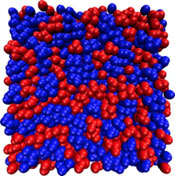
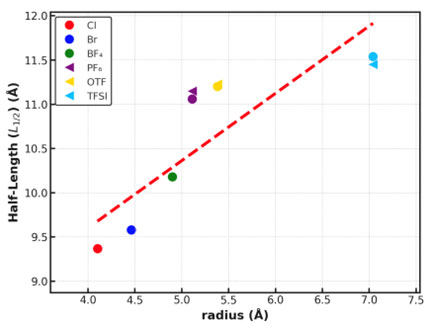
We recently proposed a model that uses computed or experimental X-ray scattering structure factors, S(Q), to determine interionic distances within polar aggregates in ionic liquids (ILs). We also introduced the concept of “half-length” by analogy to the half-life from chemical kinetics. The half-length is the distance where the radial distribution function has decayed to half its maximum value. It is thus the first mathematically and physically well-defined measure of aggregate size in liquids. Our work showed that half-lengths derived from S(Q) increase linearly as anion size increases for pyrrolidinium- and imidazolium-based ILs. In addition, half-lengths decrease as temperature increases and polar aggregates lose ions in N-methyl-N-alkylpyrrolidinium bis(trifluoromethylsulfonyl)imide ILs. Our model is general and, in principle, applicable to any scattering data for any type of soft matter. We are working to apply the model to other materials and extend it to describe the thermodynamic and dynamical properties of soft matter.
Dalbey, Emily E.; Sailor, Johnathon J.; Wheeler, R.A.; “Effect of anion size on the size of polar aggregates in imidazolium-based ionic liquids”; Phys. Chem. Chem. Phys. 2025, 27, 14296-14304.
Wheeler, R.A.; Dalbey, Emily E.; “Structure factor line shape model gives approximate nanoscale size of polar aggregates in pyrrolidinium-based ionic liquids”; Phys. Chem. Chem. Phys. 2025, 27, 4593-4602. Highlighted on the outside front cover as one of the best papers in this issue.
Wheeler, R.A.; Dalbey, Emily E.; “Structure factor lineshape model gives approximate nanoscale size of polar aggregates in the ionic liquid N-methyl-N-propylpyrrolidinium bis(trifluormethylsulfonyl)imide”; Phys. Chem. Chem. Phys. 2021; 23, 9061-9064.
Radical Polymerization Reactions
In 2023, the worldwide market for plastics was approximately $630 billion. Similarly, global plastic waste is estimated at more than 460 million metric tons. More than 40% of the world’s plastics are made by radical polymerization reactions, yet fundamental knowledge of these reactions is lacking. We have recently begun to explore quantum Monte Carlo methods to model radical polymerization and depolymerization reactions for hydrocarbon radicals. Initial studies show that fixed node-diffusion Monte Carlo (FN-DMC) achieves better than chemical accuracy (< 1 kJ/mole!!) for substituent effects on reaction enthalpies and activation energies for methyl radical addition to substituted ethylenes. Because FN-DMC is highly parallelizable and scales more slowly with increasing system size than methods of comparable accuracy, FN-DMC shows great promise for developing new transition metal catalysts for radical polymerization and depolymerization reactions.
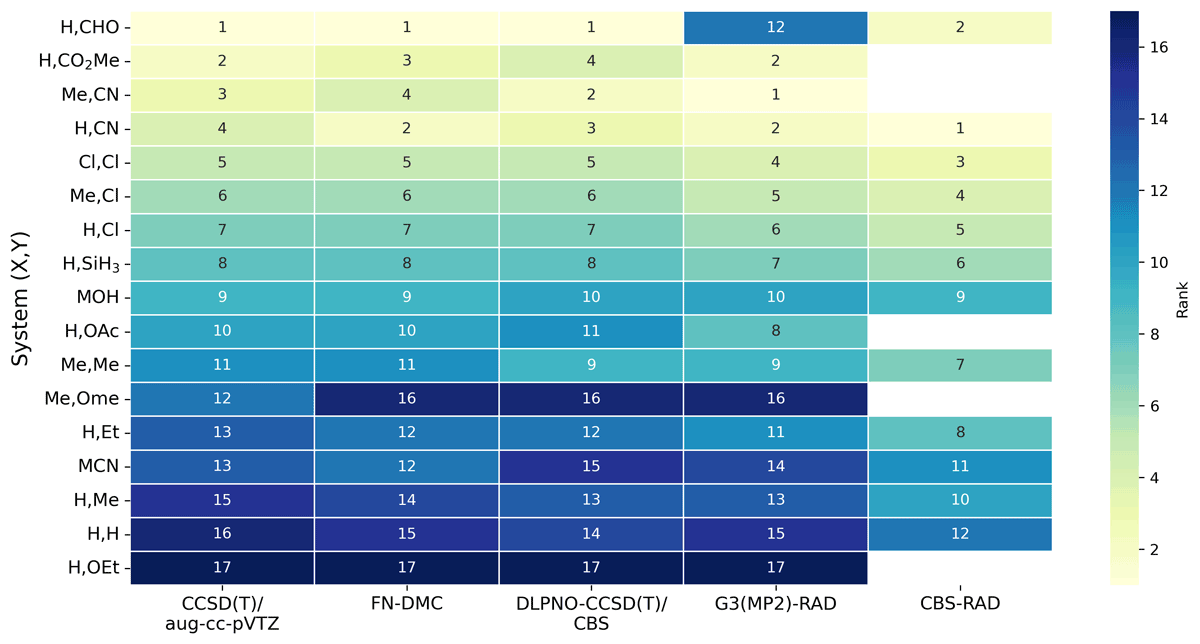
Huber, Timothy B.; Wheeler, R.A.; “Fixed node-diffusion Monte Carlo achieves chemical accuracy for substituent effects on activation energies and reaction enthalpies of methyl radical addition to substituted olefins” Phys. Chem. Chem. Phys. 2025; 27, 25282-25291. Highlighted on the outside front cover as one of the best papers in this issue.
Huber, Timothy B.; Wheeler, R.A.; “Comparing coupled cluster and composite quantum chemical methods for computing activation energies and reaction enthalpies of radical propagation reactions”; Phys. Chem. Chem. Phys. 2024; 26, 27536-27543.
Huber, Timothy B.; Wheeler, R.A.; “Fixed-node diffusion Monte Carlo shows promise for modeling reaction thermochemistry of hydrocarbon-based radicals”; J. Chem. Phys. 2024; 161, 034303/1-12.
Contact

Ralph Wheeler, Ph.D.
Board of Trustees Professor
Fellow, American Chemical Society
he/him/his
LaTourette Hall 418
rwheeler5@niu.edu